

TOP STORY
Shopify is preparing for AI shopping agents to change everything, exec says
Shopify is preparing for an e-commerce transformation driven by AI shopping agents, according to president Harley Finkelstein.
Weekly intelligence across AI, ecommerce, luxury, and jewellery.
Issue W12 · March 2026
articles analysed this week
AI’s promise to democratize productivity collides with a reality where only the largest players—like OpenAI or Bezos—can afford the upfront stakes.
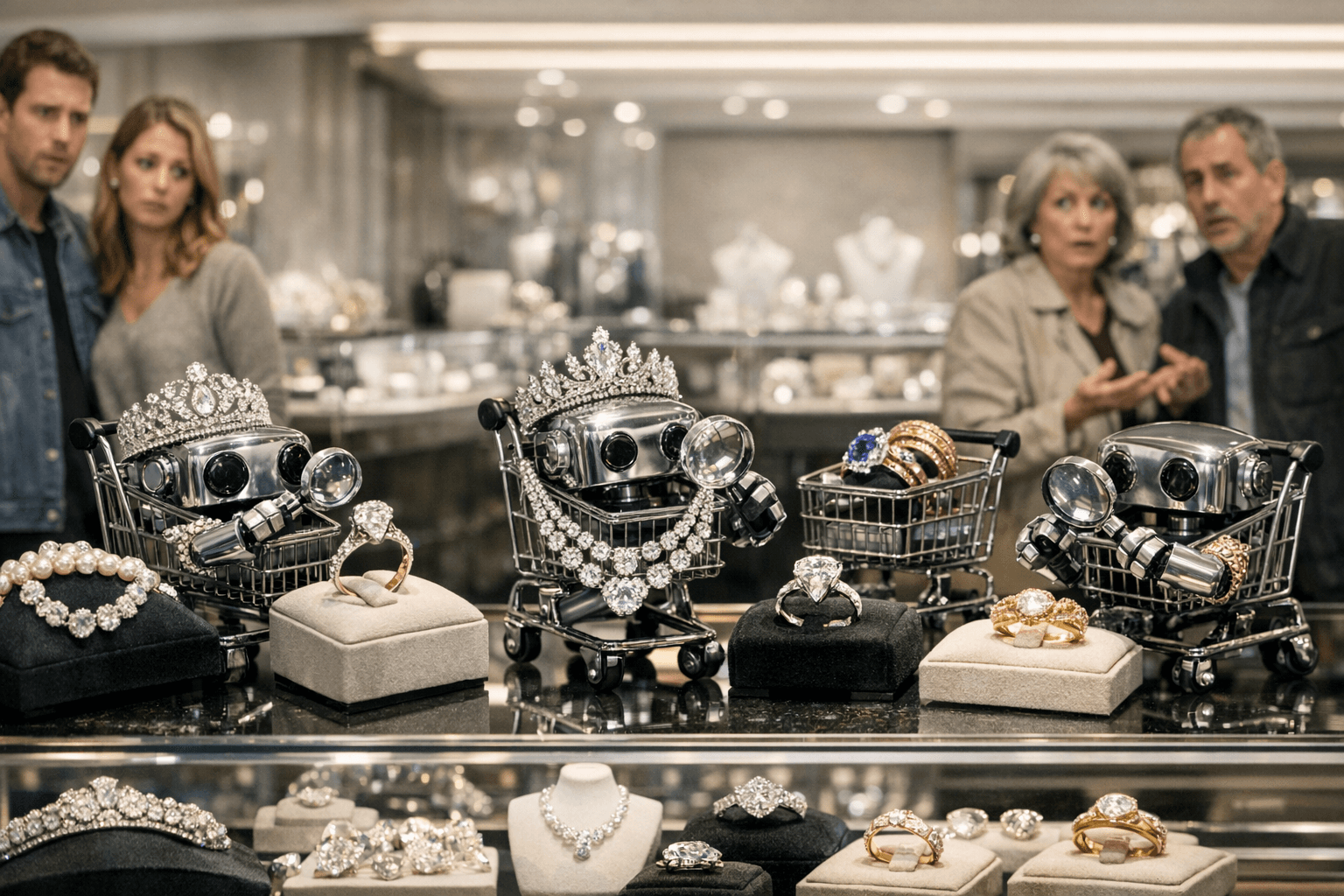
The AI arms race is forcing luxury and jewellery operators into a new kind of scale game: either you have the resources to play, or you become dependent on those who do. OpenAI’s launch of Frontier, a platform that lets enterprise clients connect their data and internal tools to AI agents, shows where the power is consolidating. Shopify’s leadership is already preparing for a world where AI shopping agents drive the entire ecommerce experience, not just search or recommendations. Meanwhile, Jeff Bezos is seeking $100 billion to buy up legacy manufacturers and refit them with AI, betting that only those with deep pockets can afford the upfront investment to modernize.
This is not just about technology, but about who controls the customer journey and the supply chain. Kering’s creation of a dedicated jewellery division, uniting Boucheron, Pomellato, Dodo, and Qeelin, signals that even the most brand-driven luxury groups see the need to centralize data, talent, and investment to compete. The fact that Alibaba’s $40.7 billion quarter was driven in part by AI and cloud investments shows that scale, not heritage, is what drives growth in the new retail order. Even on the shop floor, AI-driven dynamic pricing and RFID-backed inventory accuracy are no longer optional, they are the price of admission for omnichannel retail, as seen in the latest deployments by major ecommerce platforms.
Skeptics will argue that luxury and jewellery are immune, that heritage and intimacy matter more than algorithms. But as Signet’s strong quarter and the ongoing sales momentum among independents in Australia show, those who blend operational discipline with tech adoption are pulling ahead, not falling behind.
For luxury and jewellery operators, the next quarter is not about watching from the sidelines. It is time to audit your AI dependencies, push for direct access to your own data, and build partnerships that let you test agentic commerce on your terms. The winners will be those who treat AI not as a tool to bolt on, but as a core capability to shape every part of the business.
Weekly Luxury Intelligence · ~12 minutes
Subscribe in your podcast app: RSS feed
Digital commerce, retail innovation, DTC trends
Market moves, brand strategy, trade insights
AI news, strategy, and business transformation
Luxury brands, consumer trends, fashion
AI’s promise to democratize productivity collides with a reality where only the largest players—like OpenAI or Bezos—can afford the upfront stakes.
Rate this issue
This Week
Shopify is preparing for an e-commerce transformation driven by AI shopping agents, according to president Harley Finkelstein.
Alibaba’s fiscal Q3 revenue rose 2% to $40.7 billion as it ramped up AI, cloud computing and rapid-delivery ecommerce investments.
JD.com is promoting same-day delivery and international brands in Europe to compete with Amazon as Chinese e-commerce firms expand globally.
New E.U. law requires marketplace sellers to undergo routine verification and transparency measures.
Amazon reports customers make three times more purchases using Alexa+ on devices than with the original version.
AI agents now enable ecommerce sites to tailor pricing to each session and shopper, helping preserve margins.
Retailers are deploying RFID to provide real-time inventory accuracy, enabling agentic shopping assistants like ChatGPT and Gemini to guarantee product availability across channels.
This Week
Signet Jewelers reported strong fourth-quarter sales for the period ending 31 January 2026.
Independent jewellery stores in Australia reported another month of improved sales performance in February.
Short-sighted “caretaker” and “egomaniac” managers are identified as key obstacles limiting growth in jewellery businesses.
Lainey Wilson’s Golden West launched a new cowboy boot featuring the magnolia, Louisiana’s state flower, as a tribute to her home state.
Retail industry groups back the New South Wales government plan to strengthen protections for retail staff against crime.
Instore Magazine advises jewelers to stop asking candidates “Where do you see yourself in five years?” and suggests improved annual tax management strategies.
Goldman Sachs CEO David Solomon warned in his annual letter that risks in private credit show the financial cycle remains intact.
This Week
The U.S. government labeled A.I. start-up Anthropic an “unacceptable” national security and supply chain risk in a legal filing.
Jeff Bezos is seeking $100 billion to acquire and modernise legacy manufacturing firms using AI technology.
OpenAI launched Frontier in February as an enterprise AI agent platform designed to connect data warehouses, CRM systems, and internal tools.
OpenAI is acquiring Astral to integrate its widely used Python developer tools into the Codex AI coding platform.
Nvidia CEO Jensen Huang expects developers earning $500,000 to spend at least $250,000 on AI tokens, calling lower budgets "deeply alarming."
Russia will require foreign AI tools to store user data locally or face bans and restrictions under new rules likely taking effect next year.
Europe matches the US in AI talent and adoption but loses top startups to American investors due to missing infrastructure and a persistent funding gap.
This Week
Golden Goose is in talks to sell a 10% minority stake to Qatar Investment Authority, local media report.
Kering launched a dedicated jewellery division uniting Boucheron, Pomellato, Dodo and Qeelin, and merged fashion brand reporting to protect smaller labels.
Tomorrow Ltd., owner of Coperni and Martine Rose, is being sold to Italian buyer Andrea Ciccoli.
Dubai International Airport suspended flights after a drone incident ignited a fuel tank, coinciding with President Trump urging global action on Hormuz security.
Park Hyatt will launch 103 private residences in London’s Nine Elms neighborhood, marking its entry into the city’s residential market.
Global art market sales rose 4 percent to $59.6 billion in 2025, driven by a rebound in public auction activity.
UBS reports luxury stocks face their most bearish sentiment in years as Middle East war threatens recovery in the industry's fastest-growing market.